"Bright Spots" is an email column I write on occasion for our staff, highlighting something exciting or interesting the life of one of our staff.
Running for her Life
“Have you ever wanted to run a marathon?”
On a breezy Spring day in 2001, these fateful words wafted out of the radio station, rode the waves across town, and settled into the unsuspecting ear of one Sue W, age 45, transplanted Ohioan and X-ray Tech Extraordinaire. Sue looked up, cocked her head in thought for a fraction of a second, and then responded with a resounding, “Yes!”
Thus began the journey which landed her at the starting line of the San Diego Rock and Roll Marathon a day after her 50th birthday this summer. Sue and 25,000 other honed athletes. After the pistol, it took Sue six minutes of slow shuffling in the dense crowd to get to the actual starting point of the race, where she passed an electronic sensor, setting off a beep in the computer chip attached to her running shoes. Five hours and five minutes later….but I’m getting ahead of myself.
Fade back to 2001. Inspired by the cryptic but inviting radio ad, Sue put in a call to “Albuquerque Fit,” a division of “USA Fit” and the originator of the fateful message. Next thing she knew she was in training, along with 150 other hopefuls. All had their sights on the Duke City Marathon, some 6 months hence.
Larry the Evangelist (not his real name), an experienced runner and skilled coach, has been Sue’s mentor now for five years. You’ve got to figure a guy in his 60’s who is still running fifty mile races knows what he’s doing. Under Larry’s expert guidance, she and her new buddies built their strength and endurance a mile at a time. Every week, they got an enthusiastic lecture about running, hydration, injury, energy foods, clothing, or some other relevant topic, and tacked another mile onto their daily training schedule.
Fashion sidebar. Speaking of clothing, you experienced runners don’t laugh, but Sue actually thought she was all set from the get-go as far as her running wardrobe. “I’ve got shoes, shorts and a T-shirt; I can run!” she told her naïve self. Now, five years later, she laughs somewhat ruefully as she describes her closet. A whole drawer full of running socks. (She hadn’t even considered socks.) Another drawer full of running shorts, built of various high tech, lightweight, wick-away, friction-free streamlined materials. Stacks and stacks of running shoes. Shoes, yes, plural. This, after all, is the business end of marathon training, and life is rough where the rubber meets the road. Sue burns through one pair of shoes every 200 miles, which, for a serious foot soldier like her, takes a mere 3-4 months. The discards pile up, still too good to toss, but too old for serious use.
What am I forgetting? Oh, of course. Shirts. They don’t let marathoners go topless, no, not even in California. Sue has to have two large drawers for shirts. In one, she keeps the running shirts, first cousins to the shorts, with the same technically evolved construction. In the other drawer, the infamous Race Shirts. You know, the ones you get as a prize for entering the race, silk screened with the race name and sponsor logos. Those are usually regular cotton T-shirts, far too thick and heavy for running, and far too casual for social occasions, dahling. So they pile up like the worn out shoes, except many of the T-shirts have never been worn. No worries. Sue has a plan. Once she’s done running (Ha! Like that’ll ever happen) she’s going to have an afghan made out of them. By that time it’ll be an afghan big enough to cover her pool!
Back to our story. Sue discovered an immediate affinity for running, and for runners. She made fast friends with Cynthia and Lana, who have been regular running buddies since then. Sue learned quickly from Larry and from her own experience and improved rapidly, excited to run her first marathon at age 45. Alas, it was not to be. During the 10-mile-a-day section of her training, Sue pulled a groin muscle and had to give up on the marathon idea for the year. She was temporarily discouraged but not derailed. The next year, after healing and rehab, she rejoined the group. Two miles a day, three, four…onward, upward, and six months later she was at the Duke City Marathon starting line. Bang! Off they went. One mile, two, three….OUCH! At mile six, Sue suffered a torn meniscus in her knee, and her race was over. Foiled again! This time it was more serious, an injury requiring surgery and a year off from running.
Now, let me just pause and say that if you know Sue, you know what’s coming next. You know that a little thing like torn cartilage and knee surgery is not about to stop her from fulfilling her dream. Nossir! Maybe it’s that Midwestern stubbornness (eh, Barb?) or maybe it’s just Sue. If you saw the way she whipped our x-ray department into shape, you know what I’m talking about. Needless to say, she got back in the saddle. In the shoes. No, not the saddle shoes, the running…oh, you know what I mean. She went back to training.
What is it they say about the third time? Well, this time it was the charm. In the Duke City Marathon of 2004, Sue W. started, she ran, and by George she finished. Twenty six point two long miles. Five hours and ten minutes. Three of her best buddies ran with her. They were gnarly gals, all strong and tough, poker faced until they got to the finish line. There the sight of four proud husbands bearing flowers melted those marathon girls like buttah.
The success of her first marathon, far from satisfying Sue, just whetted her appetite for more. More races! More fitness! More endorphins and medals and fodder for the afghan! She was officially hooked.
In the next two years, Sue ran ten half-marathons and uncounted other races, including the dreaded La Luz trail race, which, in case you don’t know, is 9.2 miles straight up the Sandia mountains. Only for iron women and fools, you say? Not so. Would you believe that race draws out some 400 maniacs, including more than a few octogenarians? Believe it. As does the Sandia Peak race, on the back side of the mountain, which is a 7.2 mile grind up the ski slopes. Sue ran these and more, ran and ran, happier and stronger every year. And at the end of every race, there was her husband Jim. Proud, smiling, holding out a water bottle or a flower, offering a hug and congratulations to his strong and accomplished wife.
Spousal sidebar. Sue thinks the spouses should get medals too. Not only do they put up with their wives‘(or husbands’) training absences and smelly laundry, they drive the runners to the races at ungodly hours, drop them off, drive to the finish line and negotiate parking, then hang out with strangers, shivering or sweating, depending on the season, drinking coffee and making small talk, after which they greet the victors at the finish line with flowers and hugs, and then drive them back home, listening patiently to a detailed blow-by-blow of the race. Definitely hero material.
Which brings us back to San Diego, and the Rock and Roll Marathon. Jim dropped Sue off at the starting, er, scrum at 5:30 am. She was suited for action and loaded for bear. It’s a metaphor. But that does remind me to tell you about her gear. We could do a whole “gear sidebar” but I’ll spare you. Do think for a moment, though, about what your body might need in the course of a five hour, 26.2 mile run in the summer.
Fluids, of course. Sue carries one or two water bottles in loops on her fanny pack (of which she also has stacks, by the way, not because they wear out but because you gotta try out all the fanny pack styes to find out which one works best for which race). She also slows to a walk at the aid stations, which were set up every two miles or so in San Diego. Sue has settled on alternating Gatorade and water as her drinks of choice. She walks long enough to tank up, then takes off running again.
What else? Calories. You can’t expect your body to do that kind of work without giving it some fuel along the way. Here again, Sue has done her share of trial and error and success, through fig newtons, trail mix, Pay Day bars and the infamous “goo”. For San Diego, she settled on a nutritious combination of pretzels and jelly bellies. Mm mmMM! Breakfast of champions.
Besides those bare essentials, you’ve got to have a hat, sunglasses, sunscreen, Kleenex, a music source (in one ear and on low so you don’t miss an oncoming train or truck) and lastly, that most necessary of millennium necessities, a cell phone. Really. Think about it. Twenty five thousand people in this race, you’ve never been to this town before, and you have to find your ride at the other end. How better than cell phones?
Okay, back to the starting gate, and this time I won’t balk with the story.
After the pistol, it took Sue six minutes of slow shuffling….oh, I told that part already. So, off she went, into the So-Cal morning, feeling good and chatting with her pals. They chat the whole way, she told me. It’s a big part of the appeal. What do they talk about? “Everything, from underwear to men.” To men’s underwear, and women’s underwear, and runner’s underwear, and what, or whether, they wear under there. (Sue wasn’t telling, by the way. We’ll never know.)
They ran through the streets of San Diego, always with a view of the sparkling Pacific not far off. The neighbors were expecting them, and showered them (literally) with garden hose spray and offered fruit and encouragement. Because it was, after all, the Rock and Roll Marathon, there were even bands along the way, rocking out in rhythm with the racing feet. Entertainment on the run. There were also costumed racers in the crowd, including several Elvises, who greeted Sue and her pals with signature Presley phrases. “Hey, baby, lookin’ goooood!” It was an extravaganza.
It was also a very long way to go. In spite of her numerous other runs and races, this was “only” Sue’s second marathon and a marathon is a lot of work. One mile. Two. Three. …. Six miles, and there was Jim, to grab a quick kiss and give her a goose. I mean a boost. (It was a typo.) On she went, winding through the streets and into downtown, along the ocean and finally onto the military base, where uniformed soldiers, food booths, massage tables and a band would be awaiting them. As Sue crossed the finish line, worn out but still moving well, five hours and five minutes after she started, she pulled out her cell phone to call….who else? Her mom.
As soon as she heard her mother’s hello, Sue started sobbing and babbling with happiness and relief. “I made it, Mom! I made it! I finished! I’m done!”
Mom was thrilled. “I’m so proud of you!” (Moms deserve another sidebar, especially Sue’s mom, who vies with Jim for Biggest Fan award)
The woman running next to Sue overheard Sue’s call and started sobbing and babbling too. (It’s a neurochemical thing. Happens to all marathoners.) “That is so cool, that you called your Mom!” Sob, babble.
Who can blame them? Running a marathon at age 50 is a major accomplishment.
They deserve to be proud. Their families are proud. We’re all proud.
I asked Sue why she runs. She grinned at me around her Gyros turkey sandwich. “So I can eat!” And they do eat. The post-race feasts she described to me left me drooling. I even considered going so far as to buy a new pair of running shoes. But she can’t fool me. It’s about far more than the food. One look at Sue’s ruddy, youthful face and shining eyes (not to mention her awesome legs) and you can see the magic that running has worked on her body and life. I think she might even be getting younger.
What’s next? A well deserved retirement from running? Not even close! After a mere week off after San Diego, Sue is running almost daily again, and debating between --get this-- a triathalon and a fifty-miler for next year.
My guess? I wouldn’t be surprised if she did both.
Monday, December 18, 2006

Sunday, December 10, 2006

Blood Pressure (My latest Ask Dr Peg column)
Dear Dr. Peg,
While shopping at my local Smith's store, I stopped by the pharmacy to measure my blood pressure. The machine told me that it was 127/75. Is this a healthy blood pressure? Also, what's the relationship between blood pressure and cholesterol levels? What can I do to maintain a healthy blood pressure?
Dear Smith’s guy,
The short answers to your questions are: probably, nothing, and plenty. But I’m not one for short answers, so pull up a chair.
What exactly is blood pressure? It is the amount of pressure that your blood exerts on your blood vessels, from within them. You might liken it to air pressure in your tires, or water pressure in your pipes.
Air pressure is measured in PSI’s, or pounds per square inch. Blood pressure is measured in mmHg, or millimeters of mercury. This is because blood pressure cuffs originally used a vertical column of mercury to measure pressure. A pressure reading of 100 meant the mercury column was pushed up (against gravity) 100 millimeters.
There are two numbers in a blood pressure reading, the top number and the bottom number. Basically they are maximum and minimum readings. The top number,127 for you, is the systolic (say “siss-TALL-ick”) blood pressure. This is the pressure present in the arteries during systole (SISS-toe-lee) , which is the active squeezing phase of the heart’s pumping action. The bottom number,75 for you, is the diastolic (say “dye-uh-STALL-ick”) blood pressure. This is the pressure present in the arteries during diastole (dye-ASS-toe-lee) which is the inactive, relaxation phase of the heart.
What is normal for blood pressure? Pretty much anything less than 120/80 and still standing. Too low is when you pass out because of it. A person’s blood pressure changes throughout the day, depending on many factors. Your blood pressure is lowest when you are asleep, and highest when you are exercising strenuously.
If your blood pressure always reads between 120-140 systolic and/or 80-90 diastolic you could have pre-hypertension, meaning you could be at risk for developing the disease of Hypertension, or high blood pressure. In the pre-hypertension range, lifestyle changes like losing weight, exercising more, and eating less salt are often all that’s needed to bring your blood pressure down to normal.
If you get repeated readings with a systolic pressure over 140 and/or a diastolic over 90, you may have Hypertension. This is a bad thing. Imagine what would happen if you filled your bike tires with as much air pressure as you put in your car tires. Ka-blam, right? That’s what happens in your tiny blood vessels if they get too much pressure. The result is damage to all your organs, especially your heart, kidneys and brain.
What can you do to keep your blood pressure in a healthy range? Maintain a normal weight. Exercise regularly. Don’t smoke. Limit your alcohol intake, or don’t drink. Minimize your stress, or manage it as best you can.
Hypertension is sometimes genetic. If it runs in your family, you can decrease your chance of getting it by following the advice above, and by getting a professional blood pressure measurement once a year, during your yearly physical.
Blood pressure and cholesterol are not directly related to each other. High blood pressure doesn’t cause high cholesterol or vice versa. However, they both contribute to the same health problems (heart attacks, strokes, organ damage) and each alone can kill you. It behooves you to keep both blood pressure and cholesterol as low as possible. Beyond that, cholesterol is a topic for another day.
Finally, a word about supermarket blood pressure machines. Take them with a grain of –oops, I mean, they may not be exactly accurate. To maximize your chances of an accurate reading, rest first for ten minutes, then put your bare arm into the machine. If you get worrisome or wildly differing readings in Smiths, come in to the
Wednesday, December 06, 2006
Puppies
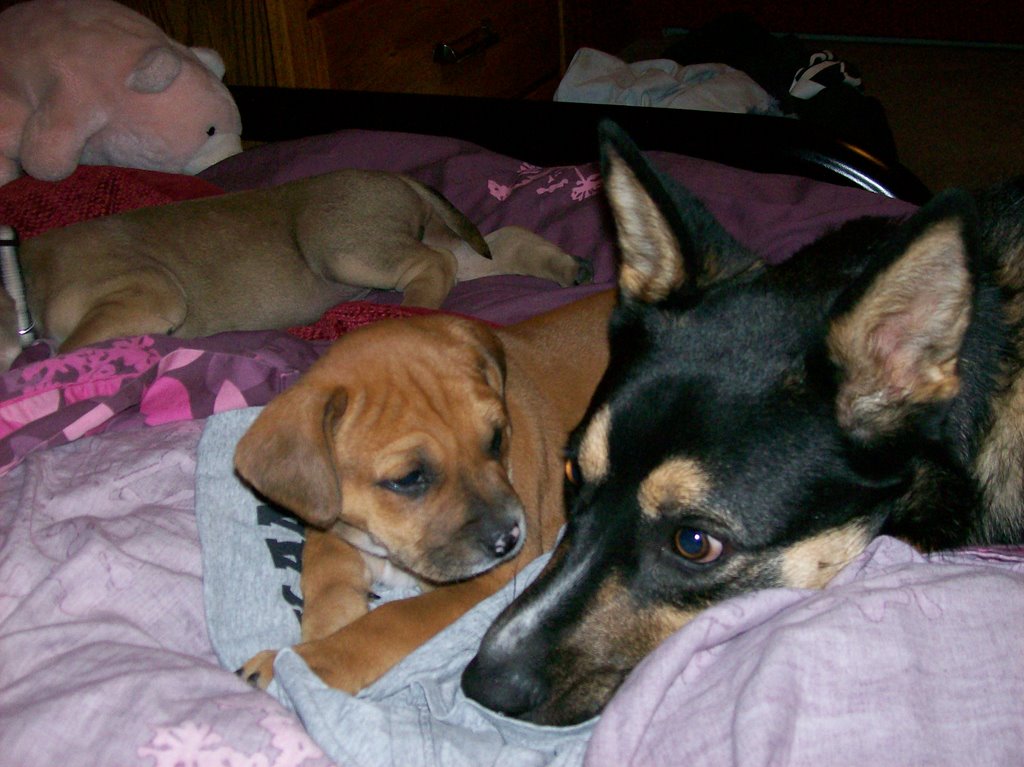
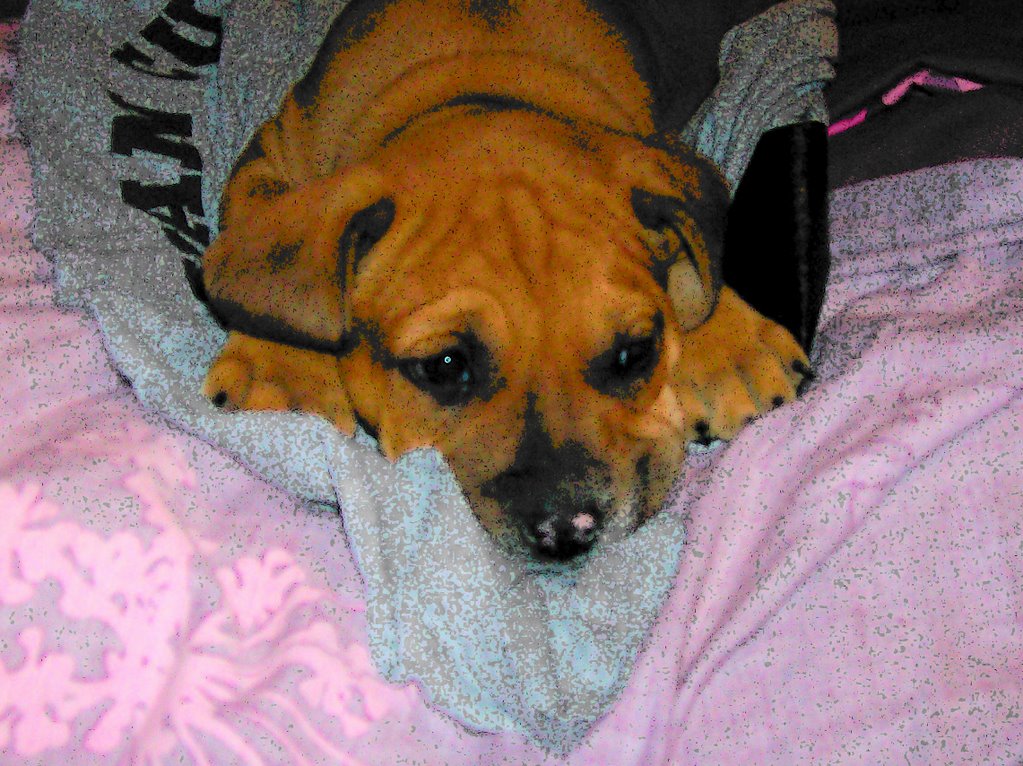
These are my daughter's two new pit bull puppies, playing with my 8 month old mutt. I'm trying out my new camera software. This is an effect called "cartoon."

Sunday, December 03, 2006
Cold Sores (my latest "Ask Dr. Peg" column)
Dear Dr Peg:
I have read your Health Columns in the Daily Lobo and have found them to be very informative and helpful. I have been concerned about a health issue since school started and would like to submit this question.
Is there an unusually high number of people at UNM with cold sores/oral herpes? It seems that they are everywhere and I am afraid that I will come down with lip sores like that. I have never had one. Is there a way to prevent getting them? Why do you think so many people on campus have this problem? What is causing this?
Thank you very much.
-Curious About Cold Sores
Dear Curious,
Great questions! I’ll do my best to answer them, but first, a few basics for those who might need them. A cold sore, also commonly called a fever blister, is actually neither. I’m talking about those round, raw-looking sores that bloom on the vermilion border of the lip, which is the junction between lip and face. They aren’t caused by cold weather, a cold, or a fever. They’re actually caused by a virus, as you suggested. Herpes Simplex, to be precise. The medical term for “cold sore” is “Oral Herpes.” Like any virus, Herpes Simplex is contagious. Oral Herpes is usually passed by direct contact (kissing, oral sex) but can also be passed by sharing items like razors or towels.
I don’t think UNM students have more Oral Herpes than anyone else. I can’t give you statistics to prove this, however, because we rarely test for this condition. It’s pretty easy to diagnose just by looking at it, and the test is expensive, so students usually decline it. Having said that, I have to tell you that Oral Herpes is extremely common in this country in general. You say you have never had a cold sore, but you might be mistaken. The American Social Health Association asserts that “50-80% of the adult population in the
Now, to cut Aunt Blanche some slack, she probably didn’t have a nasty, oozing sore when she kissed you. The problem is, she could have passed it along to you even without an active sore, or outbreak. Herpes, once it gets under your skin, takes up residence deep in the root of a nerve. It can stay there forever without ever coming out, or it can venture up to the surface and wreak havoc. Unfortunately, before the havoc, i.e. the actual sore, you can shed viruses and be contagious. Some people can tell they’re about to have an outbreak because they feel tingling or pain at the site. Triggers for the virus to make a surface foray include sunburn, stress, illness, lack of sleep….yes, basically the college lifestyle. This might be why you see a lot of Oral Herpes. Students may have more outbreaks than other, less stressed adults, even if the infection rate is the same.
How can you keep from getting oral Herpes? Stay away from Aunt Blanche! Naw, but you shouldn’t be kissing anyone with a sore on their lip, or letting them kiss you. Anywhere. Herpes Simplex comes in two subspecies – type I and type II. Type I generally prefers lips, and Type II usually prefers genitals, but they’re adaptable. Either type can live in either place. And either type can be passed from one place to the other. I deliberately left Genital Herpes out of this discussion, due to space restraints and the fact that you asked about Oral Herpes, but I’d be happy to address that another time.
If you have a cold sore, avoid kissing and performing oral sex, don’t share eating utensils or cups, and wash your hands often.
If you develop a cold sore, know that it will clear up in about a week. In the meantime, you can ask your pharmacist for topical creams or ointments to soothe your discomfort, or you can come to the
The other good news is that many people “grow out of” cold sores. They may have outbreaks for several years after the Aunt Blanche episode, but stop having them by the time they’re adults. Adults who catch the virus may notice that their outbreaks diminish over time and eventually stop.
I hope this is helpful. If you or anyone else have more questions, email me at pspencer@unm.edu. All questions will be considered, and all questioners will remain anonymous in the Daily Lobo.
Monday, November 27, 2006
The Science of Stem Cells
written for the Daily Lobo (University of New Mexico newspaper) on request for a special issue on Stem Cell research.
Immortality and unlimited potential. That’s a stem cell in a nutshell. It is an unspecialized ancestor cell, capable of living practically forever or morphing into any cell type from any tissue. Talk about power in a small package!
There are two kinds of stem cells: embryonic and adult. Embryonic stem cells come from fertility clinics. In the fertility laboratories, donor eggs are fertilized in vitro (in a test tube) and watched for a few days. After 4 or 5 days, successfully fertilized eggs have become blastocysts, which are tiny balls of cells. Some of the blastocysts are used for implantation in a woman’s uterus. The rest are frozen, destroyed or donated for stem cell research, with the signed consent of the donors. Stem cells are extracted from the center of the blastocyst and grown in cell cultures in a research lab. As long as they aren’t crowded or signaled to change, the stem cells can multiply unchanged for years. Or, given the right signals, certain genes within these cells will “turn on,” causing the stem cell to differentiate into a very specific cell type from a certain tissue. Embryonic stem cells are pleuripotent (pleuri- as in pleural, implying many, or multiple potent as in potential, meaning these cells have the potential to become any other cell in the system.
In recent years, scientists have discovered that adult humans actually retain a few stem cells. Tucked away in the lining of our intestines and the recesses of our brains, tiny swat teams of these cells huddle, breaking cover only when their home tissue is diseased or injured. These cells, also called “somatic stem cells,” help repair damage, and differ from embryonic stem cells in that they seem to be limited in their potential. In other words, unspecialized stem cells from a certain tissue can become specialized cells of that tissue, or possibly of another tissue type or two, but they are not pleuripotent like embryonic stem cells. So far, adult stem cells have been identified in brain, bone marrow, blood vessels, peripheral blood, skeletal muscle, skin and liver.
Adult stem cells have already been used in medical treatments. Have you heard of a bone marrow transplant? That is a stem cell transplant. Bone marrow stem cells become blood cells. If someone’s bone marrow is wiped out, say by radiation for cancer, they can’t make their own blood cells anymore. Give them a bone marrow transplant, and the donor stem cells take over the job, saving the recipient from catastrophe.
What else are stem cells good for? To date, the answer to this is largely theoretical, since the research is in progress. There are three general areas of research and application: regenerative therapies (like transplantation), drug testing, and development research.
The fact that stem cells can differentiate into different tissues holds promise for tissue transplants. Many diseases cause destruction or degeneration of whole organs or types of tissues. Currently, donated organs and tissues are used to replace these damaged tissues, but the demand far outweighs the supply. Stem cells could be used as a renewable source of transplantable tissues. The possibility of using adult stem cells for this purpose is especially exciting, because if one’s own stem cells could be cultured and placed back in the body, the risk of tissue rejection might be less. Some of the specific diseases being considered for these cell-based therapies are Diabetes, burns, heart disease, spinal cord injury, arthritis, Parkinson’s and Alzheimer’s diseases.
Drug testing for safety and efficacy is an obvious necessity, before new drugs are made available for medical use. At present, some cancer drugs are being tested on cells, on cancer cell lines, which are grown in a lab like stem cells. The scientific hope in this area is that stem cells can be induced to specialize into certain cell types, on which tissue-specific drugs could then be tested.
Finally, studying stem cells and the way they differentiate could give scientists a lot of information about the complex events that occur during human development, normal and abnormal. What tells cells to divide and differentiate? What goes wrong in this process to cause birth defects? What signal makes cells turn cancerous? Stem cell research is being used to understand these very complicated processes, in hopes that one day birth defects and cancer, among other conditions, might be prevented.
Exciting as these medical applications might sound, they are a long way from reality. Many fundamental questions remain. What causes a cell to differentiate? Are the signals internal to the cell or external? How do certain genes get turned on by these signals? How do stem cells remain unspecialized and self renewing for years and years? How can scientists direct a stem cell to become a specific tissue cell? How can a somatic stem cell from one tissue be used to make a different tissue? These are some of the basic questions that are being asked in research labs around the world. Only when they are answered can the medical promise of stem cells be fulfilled.
Saturday, November 25, 2006
Update on "the book"
Earlier this year I was invited to help with a book called 50 Ways to Leave Your 40s. It has been a lot of fun, an education, a trip with many twists and turns. Our original deadline was December 1st. However, s&*t happens, and the timeline has changed. Due to health problems in my coauthor's family, the book has been put on a back burner for the time being. We're now looking at a March 1st deadline or possibly even Fall of '07. The publisher is being very understanding.
So don't hold your breath or rush out to the bookstores just yet!
I'll keep you posted.
So don't hold your breath or rush out to the bookstores just yet!
I'll keep you posted.
Thursday, October 26, 2006
Scared Sexless (my latest "Ask Dr Peg" column)
Dear Doctor Peg,
I’m freaking out. I went to a great party last night, and had a fantastic time, but, well, I guess I had too much to drink, and there was this really attractive person, and one thing led to another, and we had sex. We didn’t use protection. This morning I’m sober, I have a roaring headache, I feel like an idiot, and I’m terrified. What have I done? What could happen to me? I can’t believe I did that. I’m never having sex again!
Dear Scared,
What have you done, you ask? You made some choices that put your health at risk. You are clearly regretting this as you look back with the clarity of hindsight. What could happen to you? That depends on a few things.
If you are Scared Susie, you’ll be worrying about disease and pregnancy (unless you had sex with a woman, in which case you’ll still be worrying about disease). If you are Scared Sam, it’s the possibility of disease that’s making your headache worse. Let’s take these issues one at a time.
Pregnancy. For pregnancy prevention, come to the
STI’s. This is the new and improved acronym for Sexually Transmitted Infections (formerly ST Diseases). There are several. For practical purposes, I’m going to divide them into two categories, curable and incurable.
Curable STI’s. These are infections that can be cured with antibiotics, after which they are gone from your body for good, unless you catch them again. Please note that most of these can be “silent,” meaning you can have them and not know it. We can find them for you, though, with blood, urine or swab tests. When they do cause symptoms, they are typically as follows. Trichomonas, or “trich” (pronounced “trick”) is a parasite that can cause an itchy, smelly, greenish discharge from the penis or vagina. Chlamydia is a bacterium that can cause burning with urination, a penile or vaginal discharge, painful sex or vaginal bleeding. We see several cases of Chlamydia at Student Health every year, especially after Spring Break. GonorrheaPubic lice (“crabs”) cause severe itching and rash in the pubic area. If you look closely, you might be able to see the lice themselves or their egg cases on your pubic hair. Crabs are treated topically with a cream or liquid. Molluscum contagiosum virus causes bumps that look and feel like hard pimples. Removing the core of each lesion, which we do in the clinic, helps the infection clear up more quickly. (“the drip”) causes a goopy, yellow discharge from the penis or vagina.
Incurable STI’s. For this group of infections, modern medicine has no cure. We can give you drugs to make you feel better, or to decrease the intensity and duration of your symptoms, but we can’t kill the viruses. Herpes causes exquisitely tender sores, in your mouth or on your genitals. Human Papilloma Virus (HPV) causes warts on your genitals, and some strains can cause cancer of the cervix. The good news about HPV is that there is now a vaccine that will protect you from the most dangerous strains. If you get genital warts, we’ll freeze them off, but unfortunately that doesn’t get rid of the virus, which usually lives about two more years under your skin. Hepatitis B, for which there is also a vaccine, can be silent or cause an illness with nausea, fever and bodyaches. And finally, HIV, which has a variety of symptom presentations and for which there is no known cure at this time.
I know that is quite the parade of scoundrels, and I’ve probably scared you worse by listing them all. However, chances are very slim that you’d have more than one or two of these after your wild escapade last night, and it’s likely that you don’t have any of them. The problem is, it can take weeks to months for these infections to show up in your body after you catch them.
So how long should you wait to be seen by a health professional? If you’re Susie, don’t wait for pregnancy prevention. Anyone else, make an appointment for “STI Screeing” with one of the SHC practitioners or the Women’s Health department. We will listen to you, examine you, educate you, and advise you. We might do labwork to find out if you’re positive for any of these STI’s now. We can tell you when to come back and get tested the next time. If you develop symptoms before your scheduled visit, come to the Walk-In clinic or make another appointment to be checked.
Finally, go easy on yourself. Everyone makes mistakes. Everyone does stupid things. You don’t have to swear off sex forever, or brand a big L for Loser on your forehead. Just take steps to be healthy now, and in the future, if you choose to have sex with a stranger, please, protect yourself.
Tuesday, October 10, 2006
Balloons!
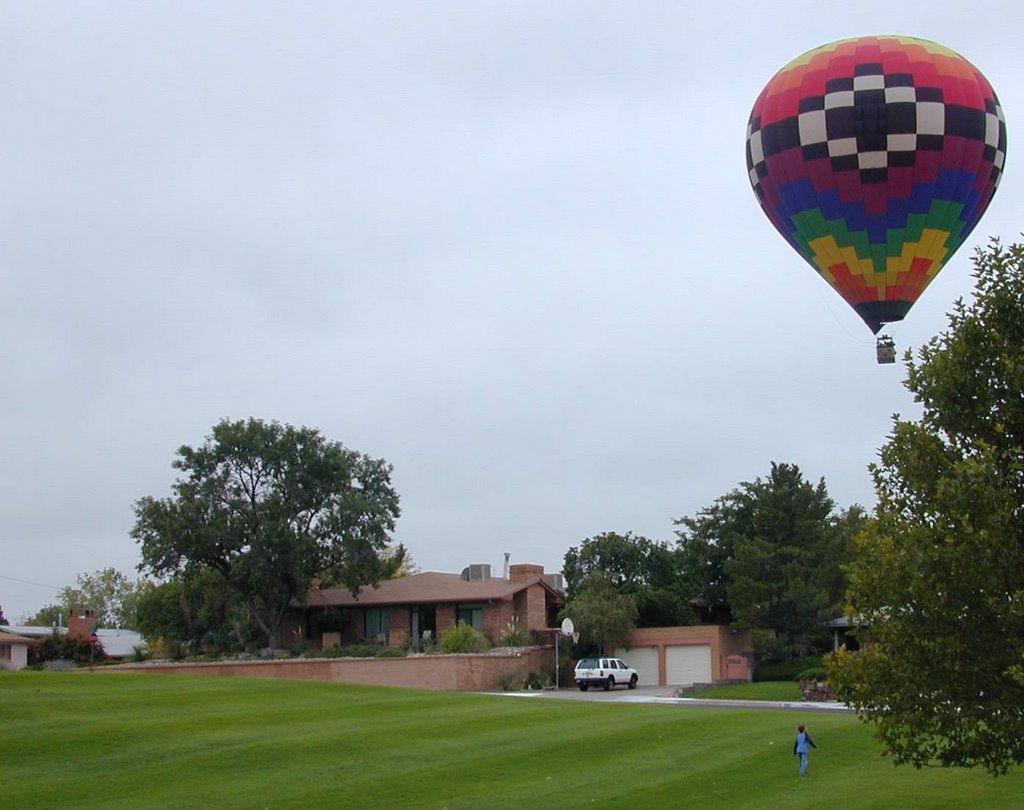
It's time for the annual Albuquerque International Balloon Fiesta. Every October hundreds of balloonists gather here, and the skies fill with color for a week. So far this week they've been thwarted by rain or wind most days, but today the sun came out and up they went.
These pics are actually from last year, taken from my house and from the park across the street. I'm too lazy to brave the crowds at Balloon Park and besides, why should I, with views like this? If they land right in front of my nose again this year, I'll add fresh pics.
It's a fun reason to come to Albuquerque, if you ever need one!

These pics are actually from last year, taken from my house and from the park across the street. I'm too lazy to brave the crowds at Balloon Park and besides, why should I, with views like this? If they land right in front of my nose again this year, I'll add fresh pics.
It's a fun reason to come to Albuquerque, if you ever need one!

The Scoop on Coffee
This is an article I wrote for our University newspaper, in response to a question someone sent in about coffee. They wanted to know if it is good or bad for them, whether it is true that coffee after heavy drinking protects the liver, and what about energy drinks? They said "like Tom Petty I have a Need To Know."
Dear Coffee Cat,
If you’ve heard good and bad things about coffee, you’re paying attention. And if you’re confused, there’s good reason, because the truth is, it’s both. Allow me to explain.
How is coffee good for you?
- It stimulates the brain. We all know that. It’s the whole reason many people indulge. And face it: even though you are smart enough to have gotten into college, there are those times when your brain could use a little extra boost. When that big paper is due tomorrow and you’re farther behind than you thought. When it’s the “morning after the night before,” and you need to function at work. At times like these, an extra mental lift can be highly useful. There is also some evidence that regular coffee drinkers have less “age related cognitive decline” than non-coffee drinkers. In other words, they kept their “marbles” longer into their old age. (The same study, by the way, found these benefits and more with green tea.)
- I’m glad you brought up the liver thing. It gives me a chance to debunk some rumors. The answer to your question is no, coffee cannot heal the liver after a long night of drinking. Coffee can’t sober you up either, contrary to popular misconception. The only thing that will get alcohol out of your blood is time, sweet time. What may be true is that – now, read this carefully – people who drink alcohol heavily, and we’re talking heavily and long enough to cause cirrhosis of the liver, can get some protective effect for their liver over the years by drinking coffee too. This is not the same thing as saying that if you binge drink all night, you can reverse the beating you gave your poor liver by going out for a latte in the morning. No. If you really want to protect your liver from cirrhosis, a far better way to do that is not to drink too much alcohol in the first place.
- Finally, coffee is often at the center of meaningful social interaction. Relaxing with a friend and having a real conversation while you sip your caffeinated beverage of choice is, in my opinion, a ritual worth honoring.
How is coffee bad for you?
- Too much coffee can give you uncomfortable jitters, headaches, anxiety, insomnia, and stomach and bladder irritation. Coffee aggravates the painful fibrocystic breast condition. It can affect the kidneys, acting as a diuretic (makes you pee). Coffee can increase your pulse and your blood pressure and contribute to ulcers. It can worsen PMS (now that is truly frightening!). All of these side effects are what we medical types call “dose related responses.” In other words, the more coffee you drink, the more likely you’ll suffer.
- Is coffee addictive? Oh, yes. If you’ve ever been a regular coffee drinker and tried to quit, you know what I’m talking about. Headaches, drowsiness, lack of concentration and focus…those, my friend, are withdrawal symptoms. Withdrawal from caffeine, the drug of choice of millions of Americans. Whether we’re “guzzling coffee like crazy fools,” taking “big gulps”of sodas or sipping tea, we consume tons of caffeine-containing products each year. If you want to jettison your caffeine addiction, I suggest you cut your consumption in half for a week, then quit. Be prepared to feel lousy for another week, but then you should be fine.
There are some “positive negatives” to the coffee story. In other words, some bad things that coffee does not do. It does not cause cancer. It does not increase your heart disease risk. In moderation, coffee and other forms of caffeine do not have significant health risks. How much is “moderation? That depends on the person. Different people have different caffeine sensitivities. For the average Joe, 2-3 cups of “Joe” a day counts as moderate consumption.
Finally, you asked about energy drinks. Those little power cans vary widely in their ingredients, including the amount of caffeine and other stimulants. Some have a lot of sugar. Some use artificial sweeteners. Most use artificial flavors and colors. Most have less caffeine than a cup of coffee, yet cost more. Since the full health effects of food additives are not yet completely known, I myself am more inclined toward the natural stuff, meaning “the bean” or “the [tea] leaf.”
I hope this satisfies your Need To Know, Coffee Cat. Now tomorrow when it’s Wakeup Time you can enjoy your java with No Second Thoughts.
Subscribe to:
Posts (Atom)


